

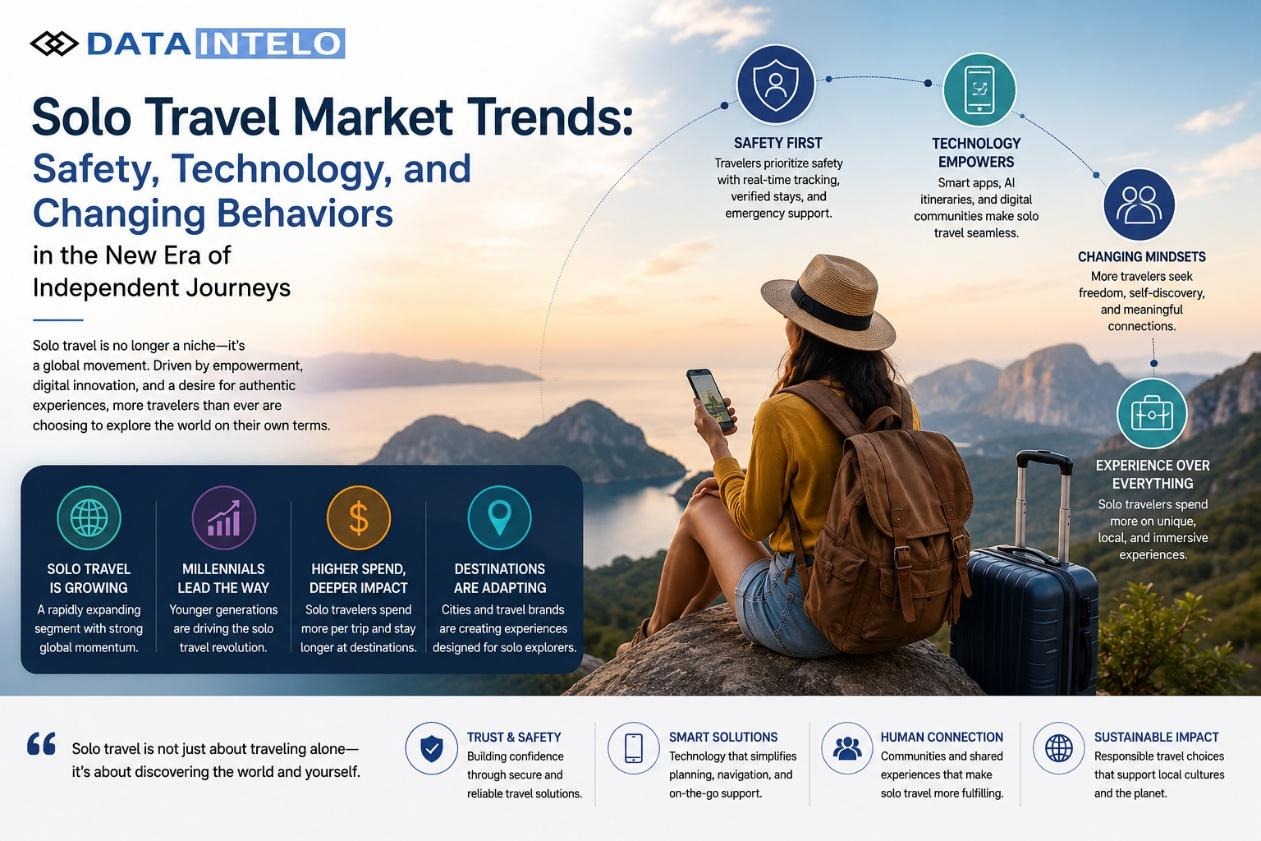
From infrequently practiced in the past, solo traveling has become one of the popular ways to travel around the globe, depending on the tendency for journeys that allow one to adjust the trip in a comfortable and easy manner. At the same time, concerns about safety issues—such as dangers presented by places to visit, health problems, and issues of privacy and fraud—are changing the approach travelers take to planning their trips. The market for the safety of solo traveling is developing as travelers, service providers, and tech companies introduce new instruments, ways of doing things and informational resources to meet these needs.
According to DataIntelo, Global Solo Travel Market Value was $623.5 billion in 2025 and expected to touch $1,312.8 billion by 2034, growing at a CAGR of 8.6% between 2026 and 2034 on the account of changing lifestyle trends, digitalization, and the global inclination towards individualism in travel. Solo travel has made its way from being just a trend to becoming a global phenomenon due to changes in social perceptions about solo travel.
Growing Popularity of Solo Travel
Surveys and studies conducted in the tourism industry reveal that the trend of individual trips is expanding among different types of age groups and regions. As a result of telecommuting opportunities, improvements in the vacation policies and the wish of a person to satisfy oneself, an ever-growing number of people are traveling alone. Solo tourism has become one of the fastest growing tourism sectors and is expected to continue to grow in the future. The existence of specialized services, information sources for vacationers, and a variety of communal tools for independent travelers’ research have all contributed to the improvement of this section of the travel industry.
Read: A Skier’s Guide to Zermatt: One of Europe’s Best Resorts
Evolving Safety Expectations and Risk Awareness
With the rise of solo travel, safety expectations are becoming more systematic and data-driven. There is a growing trend for travelers to look beyond general information and seek specifics: crime rates, women’s safety, political stability, natural disasters, health facilities.
Some of the trends in the safety approach of solo travelers are:
- The use of risk gauging indexes and evidence-based rankings that bring together various indicators and give clear directions.
- Focus on situational awareness, learning such informative tips as how to navigate in strange environments, travel using public transport and move around crowded places safely.
- Preparation of comprehensive plans for accommodation safety, transport, and emergency contacts, specifically for novice solo travelers.
These trends affect travelers’ choices regarding the destination, travel periods, and activities they are going to do.
Regional Patterns in Solo Travel Safety
Recent analyses of solo travel safety reveal significant differences in safety levels between different areas and countries. Many safe destinations have favorable conditions for independent traveling due to a good security situation, beneficial factors for independent tourists, as well as stable travel infrastructure and governance.
Several conclusions can be drawn from a recent discussion on the safety of solo traveling:
- Some countries in Europe and Asia appear toward the top of the list of safe destinations for solo travelers due to sufficient travel infrastructure and relatively low crime rates.
- Several destinations with various risk factors tend to be perceived as more risky when solo traveling due to higher levels of crime, unstable governance, or a higher probability of natural disasters taking place.
- Many popular tourist destinations are in the middle safety tier, which demonstrates that safety should be viewed as a nuanced issue rather than just a safe/unsafe element.
These observations indicate the necessity for solo travelers to seek updated and country-specific sources of information rather than relying on historical reputation alone.
Technology’s Role in Solo Travel Safety
An increasing significance of technology has been noticed in the context of solo travelers. Technologies equivalent to mobile apps and translation tools find their place within every solo traveler’s toolkit increasing their safety and sense of confidence.
The possible advances of the mentioned technologies may include the following changes:
- Chatbots functioning as travel companions and safety assistants providing travelers with advice about their route and helping them stay alert;
- Comforted notification systems helping travelers receive unexpected changes;
- Platforms collapsing the separation between safety and tours booking process.
Present technologies allow for managing risk but definitely help in understanding its terms, having a possibility to stay connected with the help of their acquaintances.
Safety Practices Adopted by Solo Travelers
Trends in the travel market are also indicative of the new practices adopted by solo travelers in terms of safety. When traveling abroad today, more travelers are intentional in how they protect their data, finances, and other aspects of their lives while on the road.
Some of the common safety practices have included:
- Sharing travel plans and contacts with family/friends before taking off, and ensuring regular contact with them during the trip.
- Using secure payment options and keeping tabs on their accounts to minimize fraud.
- Staying in areas that are easily accessible, especially to public transport and essential services, so that late-night travel in an unknown area will not be necessary.
- Preparing emergency kits that include copies of identification documents, emergency contacts, etc.
These trends show that the market of solo travel safety is about more than just products and services.
Content, Community, and Education in the Safety Ecosystem
The current trend of platforms offering solo travel services acknowledges that safety is a major concern of their audience and is taking action to meet that need. Articles, guides, case studies, and individual stories function as a conduit of complex risk information into comprehensible words travelers can utilize.
There are a few salient trends that can be identified:
- The surge of added education material intended to teach recipients how to comprehend safety indices, travel warnings, and insurance terminology in the context of traveling alone.
- An increase in interest has arisen in the development of first-person testimonials, with travelers talking about how they have overcome certain predicaments.
- The development of Internet communities and forums that enable lonely travelers to get answers to their questions, share their experiences, and learn about the experience of others who have traveled places alone.
- Through this combination of theories learned in school and demonstrations of actual events, lonely travelers can familiarize themselves with how to eliminate some possible dangers, thus making their journeys better ones.
Outlook: How Safety Trends Will Shape Solo Travel
The anticipated trajectories of solo travel safety can be expected to remain intertwined with technological innovations, improvements in global mobility, and changes in the understanding of destination risk profiles. Increasing Solo travel will lead to an increased demand for easy-to-use safety information and advice. The future trends in this area will include:
- The emergence of safety solutions integrating the destination data, traveler profiles, and real-time alerts into a single interface.
- Increased prevalence of personalized risk assessments allowing solo travelers to align the selected destinations and itineraries with their experience and comfort.
- Increased collaboration of content providers, travel businesses, and risk management companies aimed at the production of the most current and evidence-based safety guidance.
By knowing of these trends, solo travelers can confidently make better decisions before or during their trips.
Author’s Bio:
Ashish Kolte is a Marketing Manager at DataIntelo with expertise in marketing, market intelligence, and business strategy. He combines marketing insights with industry research to analyze market trends, identify growth opportunities, and global business developments.