

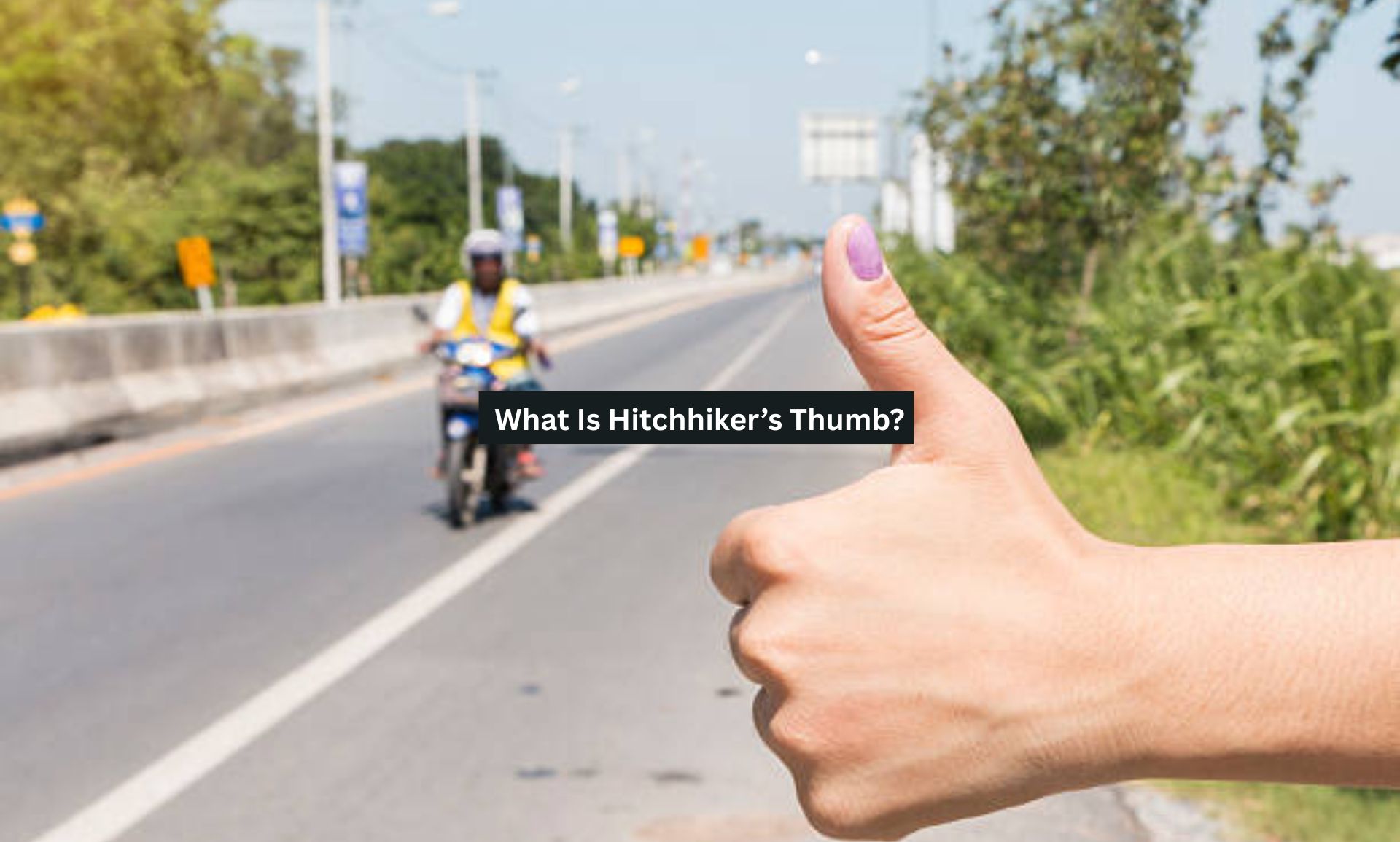
A few humans have thumbs which are hypermobile. This indicates they bend backward beyond the standard variety. The clinical term for hitchhiker’s thumb is distal hyperextensibility. It is also called Z-shaped deformity of the thumb.
Hitchhiker’s thumb isn’t painful and does now not make it harder to apply your hands.
Thumb Joints
Unlike your fingers, that have three bones (phalanges), your thumb has best bones. The primary bone starts on the tip of your thumb and extends to the knuckle. The second bone starts at the knuckle and extends to the base of your thumb.
There is only one joint for your thumb. Some people with hitchhiker’s thumb can bend this thumb joint backward as a ways as ninety degrees.
Reasons of Hitchhiker’s Thumb
There haven’t been many research performed on hitchhiker’s thumb. However researchers say that it’s an inherited circumstance.
A study published in 1953 become one of the first to investigate hitchhiker’s thumb. A total of 450 families have been studied.
A protractor was used to measure the attitude of humans’s thumbs. The researchers gave the name “hitchhiker’s thumb” to the thumbs that could bend at an attitude equal to or greater than 50 ranges. They mentioned that many people had one hitchhiker’s thumb and one directly thumb.
The conclusion from this 1953 observe became that hitchhiker’s thumb is a recessive trait.
In 2011, researchers located that in a random sample of 310 people in Nigeria, 32.3% had hitchhiker’s thumb. Of these with hitchhiker’s thumb, 15.5% were male and 16.8% lady.
In a 2007 have a look at of populations of different regions in India, hitchhiker’s thumb was located to be rarer in the ones from northern, western, and japanese India. Almost 30% of members from southern India had hitchhiker’s thumb.
Hitchhiker’s Thumb and Genetics
Our genes contain facts that specifies tendencies or characteristics which can be surpassed down from your organic mother and father. Their genes have an impact on developments together with your peak, eye shade, blood kind, and disorder danger. You get hold of one model of a gene, called an allele, from every of your parents.
If the alleles are special, the recessive one is masked by using the dominant allele, which means that best the dominant trait suggests. The trait from a recessive gene received’t show until you’ve got copies, one from each figure.
This means that if both your parents have hitchhiker’s thumb, you should have it too. However if one among your mother and father has the dominant allele for directly thumb, and the opposite has the recessive allele, you won’t have hitchhiker’s thumb.
But there has been some debate about the technological know-how in the back of hitchhiker’s thumb. An expert has argued that thumbs don’t fall into best two neat classes of hitchhiker’s thumb and non-hitchhiker’s thumb. Rather, they stated that the angles of human beings’s thumbs range, without a clear division among hitchhiker and non-hitchhiker thumbs.
Situations Associated With Hitchhiker’s Thumb
Diastrophic Dysplasia
That is a unprecedented genetic sickness that’s additionally known as diastrophic dwarfism. Human beings with this situation are generally short, with very short arms and legs. They may also have bones that broaden abnormally, resulting in club toes, spinal deformities, cleft palate, and hitchhiker’s thumb.
Diastrophic dysplasia is inherited in an autosomal recessive sample. Because of this both dad and mom have the gene, but they generally don’t have any signs and symptoms.
Atelosteogenesis Type II
A related uncommon ailment, atelosteogenesis kind II, has comparable signs to diastrophic dysplasia, consisting of hitchhiker’s thumb. But this is a miles greater severe disorder with lifestyles-threatening headaches rapidly after birth.
Hypermobility Spectrum Disorders
An estimated 30% of adults have hypermobile joints, that means that they are what a lot of us call “double-jointed.” because of this your joints, including your hips, shoulders, palms, and ankles, can flow beyond the same old variety of movement. For some human beings, like athletes and dancers, this will be an advantage. However joint hypermobility is also related to hypermobility spectrum disorders and hypermobile Ehlers-Danlos syndrome (EDS).
Hypermobility spectrum disorders consist of disorders related to your connective tissues. Those issues normally have signs and symptoms like continual pain, fatigue, and joint instability.
Hypermobile Ehlers-Danlos Syndrome
This sort of hypermobility spectrum disorders is hypermobile Ehlers-Danlos syndrome. That is an inherited sickness that affects collagen, the protein that holds your frame collectively.
Most of the symptoms are:
- Joint hypermobility
- Regularly dislocating your joints
- Slightly stretchy skin that bruises without problems
- Persistent muscle and bone ache
- Osteoporosis or thinning bones
- Early-onset osteoarthritis
Rheumatoid Arthritis
Troubles in the joints of your arms and ft are not unusual signs of rheumatoid arthritis. Rheumatoid arthritis is an autoimmune and chronic inflammatory disorder in which your immune machine mistakenly assaults your body’s tissues.
When the liner of your joints is attacked, a layer of strange tissue forms. This may smash the cartilage and bone inside the joint. Your tendons and ligaments keeping the joint together weaken. The joint steadily loses its form.
Hitchhiker’s thumb is one of the possible joint deformities. Some other joint deformities encompass swan-neck deformity, wherein the base and pinnacle joint of your finger bend and the center joint straightens, and boutonniere deformity, in which your center finger joint gained’t straighten at the same time as the joints at the quit bend lower back. In recent times, it is able to be possible to prevent joint deformities with medicinal drug.